


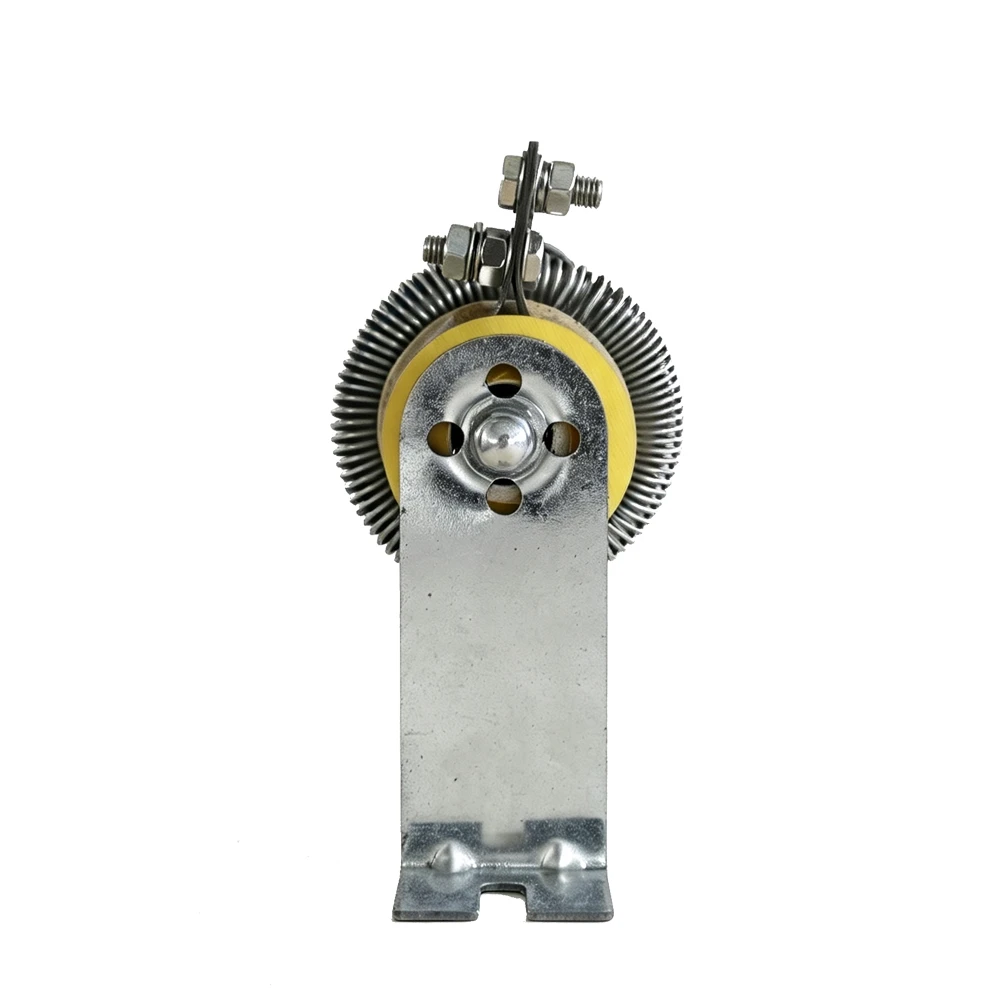
A Spring Threaded Resistor is a resistive component used in industrial electrical control systems. Its primary function is to regulate or dissipate electrical current and energy through its resistance characteristics. Depending on the electrical system design and actual application requirements, it can perform functions such as current limiting, voltage division, load regulation, and energy dissipation. It is an important component in certain industrial machines and electrical control devices.
First, a Spring Threaded Resistor can be used for current limiting. During the operation of some electrical equipment, significant current fluctuations may affect other electrical components. By connecting a Spring Threaded Resistor at an appropriate position in the circuit, its resistance can help limit the current and maintain the circuit within its intended operating conditions. This application is particularly useful in certain motor control systems and industrial electrical equipment.
Second, a Spring Threaded Resistor can be used in motor starting control. In some motor starting systems, resistors are incorporated into the starting circuit to limit starting current or improve electrical operating conditions during startup. A Spring Threaded Resistor can perform the corresponding function according to the circuit design, helping equipment achieve smoother starting control. This is particularly relevant to industrial equipment that requires frequent starting or specific starting characteristics.
Third, a Spring Threaded Resistor can also be used in braking control and energy dissipation. In certain electrical braking systems, electrical energy generated during motor operation needs to be dissipated through an appropriate circuit. Resistors can convert this electrical energy into heat, allowing them to participate in the braking process. The specific application depends on the electrical structure and control strategy of the equipment.
In addition, Spring Threaded Resistors can be used in industrial electrical control cabinets, mechanical equipment, power control devices, and other electrical systems that require resistive components. In these applications, they work together with other electrical components to provide the required circuit functions.
From a product application perspective, the helical structure offers certain space-related advantages. Depending on the design, this structure can also provide exposed surfaces that facilitate heat dissipation.
It is important to note that a Spring Threaded Resistor is not a universal component suitable for every electrical control system. Its application should be determined according to the circuit design, operating conditions, load requirements, and the product's own performance characteristics.
Overall, a Spring Threaded Resistor is mainly used in industrial electrical control applications. It performs functions such as current limiting, motor starting control, braking control, and energy dissipation, providing essential resistance functions for relevant electrical equipment.